Content type: Editorially Researched
Author: OutfitNotes Editorial Team
Published: July 16, 2026
Last Updated: July 16, 2026
Google searches for "silk scarf" hit an all-time high in early 2026, and it's not hard to see why. A single square of silk is one of the few accessories that can restyle a plain white tee, refresh a summer dress, and rescue an outfit that feels almost right but not finished. It costs a fraction of a designer bag, weighs nothing in a suitcase, and works in ninety-degree heat when a blazer would be miserable.
This guide covers seven specific, wearable ways to tie a silk scarf into a summer outfit, plus the fit, fabric, and color considerations that actually matter before you buy one.

Key Takeaways
- A 34–36 inch square silk scarf is the most versatile size, converting into a neck knot, belt, bag accent, or halter top with the same piece.
- Neutral-based prints (cream, camel, navy, black) integrate more easily with an existing wardrobe than saturated novelty prints.
- Silk twill holds knots better than silk satin or chiffon, which slip and slide.
- Under $60 options from Madewell, Quince, and Amazon perform reliably for daily wear; save Hermès and Ferragamo for occasion pieces if the budget allows.
- The most common styling mistake is picking a scarf whose scale competes with the outfit instead of supporting it.
Short Answer: How to Style a Silk Scarf This Summer
Fold a 34–36 inch square silk scarf into a long bias strip and use it seven ways: as a slim neck kerchief over a crewneck tee, a belt through denim loops, a top handle wrap on a leather tote, a hair tie replacing a scrunchie, a wrist scarf paired with stacked gold, a halter top layered over a bandeau, or a knotted dress belt at the natural waist. Stick to neutral prints in twill, keep the outfit around it simple, and let the scarf be the single point of interest.
That is the answer. The rest of this guide explains the fit, fabric, color, and pairing decisions behind each of those seven looks, plus the mistakes that make a silk scarf read costume instead of considered.
Main Factors to Consider Before Buying
Size. Silk scarves come in roughly four sizes: small (20–22 inch), medium (26–28 inch), classic square (34–36 inch), and oversized (40+ inch or rectangular). The classic square is the most versatile because it folds down for a neck kerchief but opens wide enough for a halter or hair wrap. Small scarves work only for bag handles and slim neck ties. Oversized scarves work as beach coverups but overwhelm most outfits when worn at the neck.
Fabric weight. Silk twill (the fabric Hermès uses) has enough structure to hold a knot and stay in place. Silk satin is smoother and drapier but slides out of knots and shows every finger mark. Silk chiffon is lightweight and airy but nearly impossible to tie neatly. For daily styling, twill is the answer.
Print scale. A large scale print with big blocks of color reads as the focal point and needs a plain outfit around it. A small scale print (foulard, micro geometric, ditsy floral) integrates more quietly and layers with patterned pieces. If you own one silk scarf, a small to medium scale print gets more wear.
Color base. Look at the dominant color, not the accent colors. A scarf with a navy base and coral highlights lives in the navy family and pairs with the same clothes navy does. A scarf with a cream base is essentially a neutral and works with almost everything.
Styling Recommendations: 7 Specific Ways to Wear It
1. Slim Neck Kerchief Over a Plain Tee
Fold the square into a triangle, then roll the long edge in until it's a two inch bias strip. Wrap around the neck once, knot at the side of the throat, and let the tails sit against the collarbone. Wear over a crewneck white tee, high waist jeans, and loafers. This is the outfit that makes people ask where you bought your tee.
2. Belt Through Denim Loops
Roll the scarf into a longer, narrower strip (fold in thirds, then thirds again). Thread through the belt loops of straight-leg or wide-leg jeans and knot at the front, letting the tails hang three to five inches. Works best with a tucked-in tee or a fitted knit. Skip if the jeans have very tight belt loops that will crush the silk.
3. Top Handle Wrap on a Leather Tote
Take a 20–26 inch scarf (or a folded larger one), tie it in a small bow or knot at the base of the handle where it meets the bag body. This is the classic "Hermès on a Birkin" move, and it works on a $200 tote just as well. It adds color to a neutral bag and gives a plain leather work bag a personal touch.
4. Hair Tie Replacing a Scrunchie
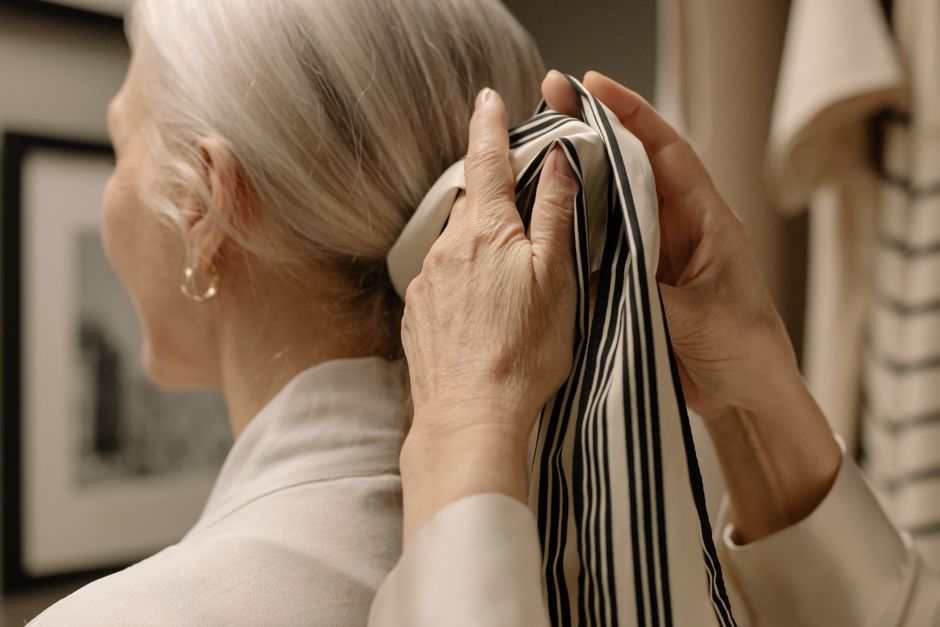
Fold the scarf into a bias strip, tie a low ponytail with a plain elastic, then wrap the scarf around the elastic and knot it with the tails hanging. Works with a half-up style, a low ponytail, or a bun. Twill holds better than satin here because satin scarves slip out of the hair as you move.
5. Wrist Scarf With Stacked Gold
Fold into a slim strip, wrap twice around the wrist, and tie a small knot. Stack next to a gold cuff, watch, or a few thin bangles. This is the alternative to a bracelet when a bracelet feels like too much for a summer dinner outfit. Keep the rest of the jewelry restrained so the scarf reads intentional.
6. Halter Top Over a Bandeau
Take a 34–36 inch square, fold in half to make a triangle, and tie the top two points behind the neck with the point of the triangle facing down. Layer over a plain bandeau or bralette for coverage. Pair with high waist trousers or a midi skirt. This is a going-out look, not a workwear one.
7. Knotted Dress Belt at the Natural Waist
Fold the scarf into a wide bias strip and tie around the waist of a shift dress, wrap dress, or button-down dress. Knot at the front or the side, not the back. This adds shape to a straight-cut dress and pulls in a slightly oversized one without needing a leather belt.
Fit and Proportion
The scarf should be a supporting player, not a competing one. A few proportion rules that keep the outfit from looking busy:
- If the top has a busy print, the scarf goes on the bag or the wrist, not the neck.
- If the outfit is monochrome, the scarf is the one place color enters.
- The visible length of the scarf tail should be roughly the width of the palm, not brushing the waistband when tied at the neck.
- On petite frames, use a 26–28 inch scarf at the neck; the 34+ inch feels oversized on a smaller collarbone.
- On broader frames, the 34–36 inch scarf sits more balanced at the neck than a small square, which can look like a choker.

Fabric and Color Guidance
Twill vs satin vs chiffon. For a scarf that will actually get worn seven ways, silk twill (14–16 momme weight) is the practical choice. It holds knots, resists slipping, and shows print colors cleanly. Silk satin looks luxurious flat but performs worse tied. Silk chiffon is best reserved for hair or as a lightweight wrap.
Care. Real silk needs cold hand wash or dry cleaning. Twist gently to remove water, lay flat to dry, iron on the silk setting through a pressing cloth. Never wring or machine dry. A silk scarf that gets thrown in a washing machine on hot will lose its hand within one wash.
Color base for a wardrobe. If choosing one scarf, a cream or navy base with a small foulard print works with the widest range of clothes. Second scarf: a saturated color (coral, olive, mustard) to add interest when the outfit is neutral. Novelty prints (animals, letters, cities) are harder to pull off unless the rest of the wardrobe is very restrained.
Where to shop under $60. Madewell carries silk bandanas around $30–45 with cotton-forward prints. Quince offers a pure silk scarf at approximately $50 with clean geometric designs. Amazon's silk scarf category has legitimate mulberry silk options in the $25–40 range, though print quality varies; look for listings that specify 100% mulberry silk and momme weight. Vintage silk scarves from consignment sites often outperform new mid-market options for the price.
Where the money makes sense. Hermès and Ferragamo carreés (roughly $500 and $400 respectively) are heirloom-quality with hand-rolled edges, denser silk, and prints that stay vivid after decades. They are not necessary. They are a preference.
Common Mistakes
- Choosing a print scale that fights the outfit. A large-block Hermès-style print worn with a busy floral dress creates visual competition; neither piece wins.
- Using slippery satin at the neck. Twist a satin scarf and it will unravel by lunch. Save satin for hair.
- Overtightening the neck knot. A choked scarf looks stiff. Leave a two-finger gap between the knot and the throat.
- Matching the scarf too literally to the outfit. A blue scarf on a blue dress reads as an accident. Contrast is the point.
- Wearing a scarf with a chunky necklace. Pick one focal point at the neckline, not two.
- Skipping the iron. A creased silk scarf looks tired. A pressed one looks intentional.
Outfit Examples
Weekend brunch. White crewneck tee, straight-leg denim, tan leather loafers, small crossbody, and a cream-based foulard scarf as a slim neck kerchief.
Office day. Ivory silk shirt, navy tailored trousers, pointed flats, black leather tote, and a navy-based scarf tied to the tote handle.
Summer dinner. Black slip dress, gold hoops, strappy sandals, and a coral-based scarf as a knotted dress belt at the natural waist.
Travel day. Cream sweater, wide-leg jeans, white sneakers, canvas tote, and the scarf folded and tied to the tote handle for airport, then repurposed as a hair tie once you land.
Casual date. Fitted tank, high waist wide-leg jeans, mules, gold cuff, and a scarf wrapped twice around the wrist.
Beach dinner. Bandeau top with the scarf tied as a halter over it, high waist linen pants, flat sandals.
Working from a cafe. Boat neck striped tee, cropped straight jeans, ballet flats, and a small foulard scarf tied on a leather crossbody strap for a personal touch.

Frequently Asked Questions
What size silk scarf is most versatile?
A 34–36 inch square (roughly 90 cm) is the most versatile because it folds down for a neck kerchief but opens wide enough for a halter, hair wrap, or dress belt. Smaller scarves are limited to bag handles and slim ties.
Can I wear a silk scarf in summer without overheating?
Yes. A silk scarf folded into a slim bias strip covers very little surface area at the neck and, unlike synthetic fabrics, silk breathes well. Skip the full triangle drape over the shoulders in ninety-degree weather.
How do I keep a silk scarf from slipping?
Choose silk twill instead of satin, and use a small square knot rather than a loose loop. For hair styling, tie the scarf around a plain elastic that grips the hair, not the scarf itself.
Is a $30 silk scarf worth it or should I save for Hermès?
A well-made $30–60 silk scarf from Madewell, Quince, or a reputable Amazon mulberry silk seller performs the same seven ways for daily wear. Hermès and Ferragamo are heirloom purchases with hand-rolled edges and denser silk, worth it only if a scarf is a genuine wardrobe priority.
Related OutfitNotes Guides
- How to Build a 30-Piece Capsule Wardrobe
- Best Aritzia Summer Pieces 2026: 7 Editor Picks
- How to Style a Polka Dot Dress: 7 Outfit Formulas
- How to Pack for 10 Days in a Carry-On
Sources and Research Notes
- Google Trends data for "silk scarf" search interest, United States, January–June 2026.
- Product availability and pricing checked on brand websites (Madewell, Quince, Hermès US, Ferragamo US) on July 15, 2026.
- Silk fabric weight (momme) and care guidelines cross-referenced against Textile Society of America published resources and standard silk industry references.
- Styling techniques based on published editorial fashion resources and knot construction that holds in twill weave.